
Aloha,
Our 2025 Whale Watches ended with a splash, or to be more accurate…HOURS of splashes.
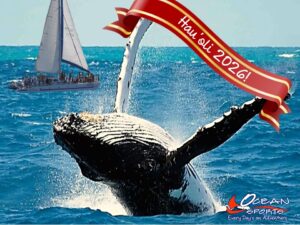
Guests on our Wednesday Wake up with the Whales Cruise watched over an hour of tail lobs and pectoral slaps from two adult Humpbacks just south of Anaeho’omalu Bay. These whales were a couple of miles from shore, but didn’t seem to care at all when we stopped 100 yards from them. They were definitely interacting with each other and we could tell that we were not nearly as interesting to them as they were to us.
We took a right hand turn out of the bay and headed north to begin our Late-Morning Whale Watch Cruise. After driving around for awhile, we finally saw some splashes way to our south so we turned the boat around and headed that way. When we got a bit closer, we realized we were watching a lone Humpback tail lobbing. We couldn’t figure out what was incentivizing this whale — often when we see repetitive surface activities, we interpret them as an “announcement” to another whale in the vicinity (“Hey, look at me…I’m over here”…”I’m strong and healthy”…or even “I’m irritated”). Eventually though, our lone whale was approached by a much bigger Humpback and after a couple of breaths at the surface, they both lifted their flukes and sounded — which was a great way to end our 2025 Whale Watch Cruises.
Mahalo and Hau’oli Makahiki Hou,
Claire
Ocean Sports Whale Fact of the Day: A week ago or so, I promised I’d outline the rules regulating human to Humpback interaction. In 1966, the International Whaling Commission banned most nations from hunting Humpbacks. In the U.S., the Marine Mammal Protection Act of 1972, and the Endangered Species Act of 1973 provide additional protection to the whales. And though the Humpbacks are now no longer “officially endangered”, unless you’re operating under a federal research permit, approaching humpback whales within 100 yards (300 feet) by any means (boat, swimming, kayaking etc) or within 1,000 feet from aircraft is still prohibited. It’s also prohibited to approach the whales closer than 100 yards by interception (i.e. you can’t “hop-scotch” in front of them), or do anything that would disrupt their “normal behavior” or “prior activity”.