
Aloha,
We operated just one guaranteed Whale Watch Cruise on New Year’s Day, and it was a fun one.
Guests joining us for our Late-Morning Whale Watch Cruise saw some spouts to our north as soon as we exited the bay. These whales were pretty far out to sea, so we kept our heads on a swivel and noticed some spouts to our south too.
Captain Will made the executive decision to head out to those whales to our north though, and as we approached we learned we were actually watching two whales, and we got to see them pec slapping repetitively. As you may already know, the scientific name for the Humpback is Megaptera novaeangliae, which translates to “Big Winged New Englander” (they were named for the North Atlantic Humpbacks), and they’re aptly named. Humpbacks’ pectoral flippers are about a third the length of their bodies (think around 12 – 15 feet long for fully grown whales), so when a Humpback lifts her flipper into the air and then slaps it on the surface of the water, it’s a big deal. Later in the cruise, one of these pec slapping whales breached too, and almost all of us were looking in the correct direction to see it.
Towards the end of the trip, we were surprised when we encountered a 5′ long hammerhead shark just hanging out at the surface. We saw his dorsal fin and caudal (tail fin) first, and from a distance we weren’t sure if we were looking at a tiger shark or a reef shark (we knew it wasn’t a whale or a dolphin, because it wasn’t spouting). But this shark wasn’t spooked at all by our approach, and as we got closer we got to see his bizarrely shaped head. The shark swam around for about 15 minutes at the surface before slipping underwater.
Mahalo.
Claire
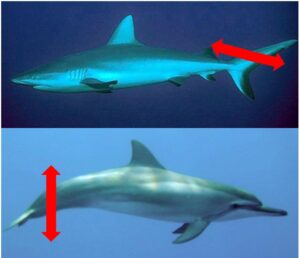
Ocean Sports Whale Fact of the Day: Do you know the easiest way to distinguish whether that big creature swimming rapidly towards you is a whale or a shark? Watch the way it swims…whales propel themselves through the water by moving their tails up and down vertically. Sharks and other fish move their tails from side to side (see the image above). Aristotle was the first person to document this difference around 350 B.C. – hopefully you’ll never need to use this information for anything other than winning a trivia contest!