
 Aloha,
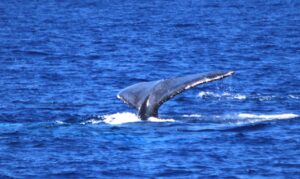
It was another windy day on Monday, but not too windy to get out to see the Humpbacks. Just after we left the bay on our Wake up with the Whales Cruise we saw 5 or 6 breaches from whales straight offshore from us, but due to the wind, we really couldn’t rush out to see them. Luckily, we saw some spouts to our north, so Captain Kai decided to take a turn to the right and try to stay inside of the lee created by the mountains. Our northern spouters turned out to be a couple of pairs of Humpbacks. None of them were doing a whole lot while they were on the surface, but when they decided to dive, each lifted their flukes really high up into the air. Usually “tails up means whales down” (referring to the fact that the straight-up fluke posture generally precedes a deep dive), but in this case, each of our 4 whales wasn’t spending a lot of time underwater. And short dive times translates into lots of opportunities to see them on the surface too. All of our whales were travelling south, so we were able to parallel their course back to the bay. In between sightings of these close-by whales, we saw lots and lots of splashes from breaching and surface active whales out on our horizon line. Were these whales reacting to the strong winds offshore? See today’s Fact of the Day for more on that.
We were hoping the wind would settle down a bit during our Late Morning Whale Watch Cruise, but it held steady. This time around our first sightings were a bit south of the bay. We watched 3 Humpbacks (one pair and one loner) surface and spout several times about 100 yards from us. The loner was off our bow, and the pair off our starboard side, so everyone aboard got to see them. The highlight of the cruise though was when a pair of whales started breaching about 150 yards off our stern. First one breached, and then his buddy breached, and then they started breaching simultaneously 5 more times. Alala’s stern area isn’t as big as her bow, but by the time these whales were on their second breach, all of us were in a good place to watch the action, and to be honest, we were all blown away (and not the “windy” kind of blow away – we were downright awestruck). Towards the end of the cruise we had one more close encounter with a Humpback who surfaced just 75 yards from us to take a look at us. This whale spouted a few times and then sank under the water, apparently satisfied with what he saw.
Mahalo,
Claire
Ocean Sports Whale Fact of the Day: Humpback whale communication signals comprise two different types: vocal signals, and surface-generated signals such as ‘breaching’ or ‘pectoral slapping’. Back in 2010, researchers reported that humpback whales gradually switched from primarily vocal to primarily surface-generated communication in increasing wind speeds and background noise levels. Why? Surface-generated sounds have energy distributed over a greater frequency range and may be less likely to become confused in periods of high wind-generated noise. Therefore, it may be easier for the whales to communicate to each other by splashing when it’s windy.