
Aloha,
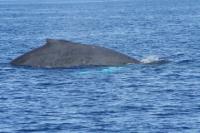
We had a real dilemma when we left the bay for Tuesday’s Wake Up with the Whales Cruise. We saw spouts all over the place, but ultimately decided to head north towards where 3 distinct pods of two Humpbacks each were surfacing and spouting. We stayed in that area for about 30 minutes, listening to a lot of very loud and clear Humpback voices through our hydrophone while waiting to see if any of our 1/2 dozen whales would become more active at the surface. We got to see all of them frequently, and though none of them lifted their flukes high into the air to begin deep dives, we did get to see lots of “humps” as they began their shallow dives. Later, one of our pods of two started doing some frequent pectoral slaps aimed ostensibly towards each other (but of course, they may have been communicating their location or size or health or mood to the other whales in the area — those slaps make a LOT of noise). As we ran out of time on this cruise, we got to see a final pec slap followed by a synchronized dive from our pod of two — a great finale for this cruise.
Our Late Morning Whale Watch Cruise began the same way as our first cruise of the day did — with multiple spouts from pairs of Humpbacks and loud, clear sounds on our hydrophone. But during this cruise, we encountered a Mom/Baby duo who were really active on the surface. Baby was in an exploratory mode and Mom was very permissive. The two did a loop around our idling boat coming within about 20 yards of us. After they headed out, we did too, and found a pair of adult Humpbacks offshore of the Mauna Lani Resort. We watched one of them breach 5 times over the course of 15 minutes, and pec slap a bunch too. On our way back to the bay, we saw too many spouts to count but of course we were running out of time and weren’t able to head back out to sea to investigate.
Mahalo,
Claire
Ocean Sports Whale Fact of the Day: Research suggests that most Humpbacks who come to Hawaii don’t spend the entire winter with us. An average stay lasts between a month and 6 weeks. Possible exceptions to this rule include dominant males, who may spend more time here to optimize mating opportunities, and females who give birth after arriving in Hawaii. They might spend a little longer here so that their calves can grow large enough to successfully swim back to Alaska.