
Aloha,
The surf was rolling in when we left the Bay for Tuesday’s Wake Up with the Whales Cruise, and the wind was blowing too. A big swell doesn’t affect us much when we’re at sea, but the windy conditions meant we couldn’t travel quickly to visit the Humpbacks we were seeing.
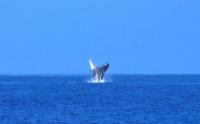
Throughout the 90 minutes we were at sea, we easily saw evidence (spouts, splashes, and various shiny black body parts) from at least 10 different Humpbacks. We started paralleling a pod of 4 whales, but they were on 20 minutes dive cycles, and after awhile, it seemed like they had split up underwater and went their own ways. Before they broke up, we got to see (and hear) them all at the surface about 100 yards from us — and we also got to see them from a bit further away on a couple of other occasions. Meanwhile, there were whales breaching in every direction we could see, but the wind prevented us from investigating any of these breachers from our “magic” 100 yard line.
Mahalo,
Claire
Ocean Sports Whale Fact of the Day: Generally, the longer a mammal lives, the more likely it is to develop chronic diseases like cancer. Since Humpbacks and many other baleen whales have lifespans equivalent to ours, when you think of it, it’s kind of amazing that they don’t get cancer. A couple of years ago researchers investigating this anomaly came up with a possible reason why we don’t see cancerous tumors in big baleen whales. It turns out that cetaceans have many more Tumor Suppressing Genes than humans, and that the turnover rate for these genes is 2.4 times faster than it is in other mammals (in other words, their genes continually “fight” tumor formation). As an aside, the researchers also found that mutations in the genes that are biomarkers for some common human cancers are also correlated with hair loss…and a lack of body hair is certainly noticeable among cetaceans. Interested in learning more? Click here to read the published research article.