
 Aloha,
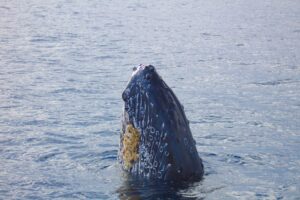
What do you do when a Humpback just won’t leave you alone? That was our dilemma during our Thursday Wake Up with the Whales Cruise. Besides seeing several breaches from whales a couple hundred yards away and spouts from Humpbacks in all directions, we found ourselves the object of interest for a lone Humpback. This whale came right up to our idling boat and lifted his head vertically out of the water to peer at us (spy-hopping). He also spent a good 10 minutes just circling us right under the surface. Was he bored? Or did he recognize us from previous Whale Watch Cruises? We really have no way of knowing, but it sure was an incredible experience for us (and hopefully, for him too).
Guests on our Late Morning Whale Watch Cruise got to see some breaching and pec slapping from whales a bit further out to sea, and spouts from 7 or 8 different Humpbacks. At one point, we were surprised when a lone Humpback surfaced just 50 feet from us, but after a single breath, this whale slipped back underwater. The highlight of the trip was the Humpback songs…we had our hydrophone deployed and listened to some of the loudest singing we’d heard in a long time. Our naturalist Sophia described the unique sounds we were hearing as “almost orca-like” (unfortunately, we didn’t get a recording). Towards the end of this cruise, a pod of Spinner Dolphins cruised over to the boat to play in our bow wake.
Mahalo,
Claire
Ocean Sports Whale Fact of the Day: When we deploy our hydrophone (or put our heads below water) during the wintertime, we’re always fascinated by the sounds we hear the Humpbacks making. We know they don’t produce sounds the way we do — in order to sing or talk, we pass air over our vocal cords. If we could do this underwater, bubbles would rise from our mouths to the surface. When our Humpbacks vocalize, no bubbles rise to the surface, and in fact, Humpbacks don’t have vocal cords like we do — so how do they produce those haunting sounds? A couple of years ago, researchers at the University of Southern Denmark experimenting on deceased beached Sei, Minke and Humpback whales took a look in these whales’ larynxes and found a U-shaped tissue and a large “cushion” of fat and muscle not found in other animals. They found that when they blew air across the fatty U-shaped folds, it pushed those folds against the fat and muscle cushion, creating vibrations that actually matched the sounds that the living whales make in the wild. So…that’s HOW the whales sing, but exactly WHY they sing is still under investigation.