
Aloha,
We managed to pull off one Whale Watch Cruise on Monday before the storms moved in — our Wake Up with the Whales Cruise.
The cruise began with sightings of spouts from a pair of Humpbacks who were pretty far out to sea. Since we could see a windline out there (the edge between the calm ocean and the stirred up ocean) Captain Ty thought it wouldn’t be wise to go out to investigate. Instead, he kept the boat in the lee, and steered north towards Puako. We saw some splashing up that way which our onboard naturalist DJ thought at first was from a Humpback calf breaching. As we got closer, it turned out that what we were actually watching was a Manta Ray breaching. Of course no one really knows why Manta Rays breach — it could be for the same reasons whales breach (communication, removal of parasites, courtship, feeding, or maybe just playing around) — but we hardly ever get to witness it, and it sure was fun to see.
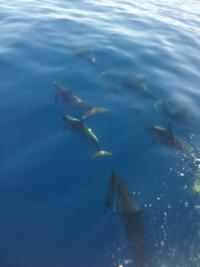
Later in the cruise, a pod of Spinner Dolphins veered over to play with the boat for awhile, and after that, we got to see 4 more Manta Rays swimming at the surface. Finally, some of us saw one more spout from a lone Humpback who was swimming offshore of Kawaihae Harbor, but again, this whale was too far away for us to investigate.
So, though we saw evidence of three Humpbacks, Spinner Dolphins, and Manta Rays (both breaching and swimming), it wasn’t enough for us. We called the trip a “Fluke” (though it was the most fun “Fluke” we’ve ever operated), and invited everyone to join us again on another Whale Watch Cruise for FREE.
Mahalo,
Claire
Ocean Sports Whale Fact of the Day: If you were a researcher wondering whether ancient whales migrated along the same routes (or any routes for that matter) as our modern whales do, how would you go about answering the question? A PhD candidate at the University of California, Berkeley has a novel solution. He’s studying the fossilized shells of barnacles that had lived on these ancient whales. He found that you can actually look at the composition of the oxygen isotopes in the different layers of a barnacle’s shell and extrapolate where the whale was swimming and the temperature of the water the whale was swimming through when each particular layer of shell was laid down. Based on his findings, we know that whales have been living the migratory lifestyle for millions of years! Fascinating. You can read more about this research here.